
New Offering: Turn Your PV Plant's Existing Grid Connection Into a Second Revenue Stream
Updated: Aug 23
Greenbox Co-Location battery storage solution for PV park owners and operators
If you own or operate a ground-mounted PV plant, there's a good chance its grid connection point sits idle for large parts of the day — and that unused capacity is now a monetizable asset. Greenbox Energy Solutions is launching Greenbox Co-Location: a battery storage solution that pairs directly with an existing PV plant, uses its already-approved grid connection, and turns idle capacity into additional income — without the plant owner having to become a battery expert.
What is "Greenbox Co-Location"?
A Greenbox Co-Location storage system is a battery that is charged exclusively from a renewable generation asset, typically at the very same grid connection point. The dispatch logic is simple and fully automated:
When spot market prices are low, the PV plant doesn't export to the grid — it charges the battery instead.
Once the battery is full, or exporting becomes more attractive, the PV plant resumes feeding the grid directly.
Once the sun goes down, the grid connection is used to discharge the battery — typically during high-price hours.
The grid connection point and the battery's size are the key constraints that determine how much can be charged and discharged.
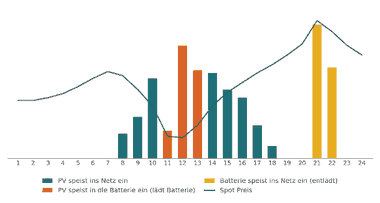
The illustrative chart below shows what a typical day can look like: the PV plant feeds the grid directly through the morning and afternoon (teal), diverts surplus generation into the battery around midday when prices are weak (orange), and the battery discharges into the grid in the evening price peak (gold) — all governed by the spot price curve (grey line).
The revenue opportunity
Because the battery only ever charges from renewable generation, its output competes for the best-priced hours on the market — and that spread is worth capturing. Based on a backtest of the German market (source: Impuls Energy Trading, June 2025–May 2026), pairing a battery with a PV plant at a 1:1 power ratio increases the plant's total revenue by up to 128% through multi-market trading and load-shifting into hours when the PV plant itself has stopped generating. Oversized ("grey power") storage configurations can go even further, up to roughly 208%.
To make this concrete, here's an illustrative example for a 1 MW / 2 MWh system — a common starting size for co-location projects:
Typical investment: in the order of €480,000 net, all-in (storage, electrical integration, metering concept, fire protection, and planning) for a first build-out stage.
Typical annual revenue: in the order of €80,000–120,000 per MW per year from arbitrage, frequency reserve markets (FCR/aFRR), and avoiding losses during negative-price hours — before operating costs and marketing fees.
Indicative payback: around 6 years, driven mainly by the price spread the battery captures on top of the PV plant's own income.
These figures are illustrative and will vary by site, market conditions, and system size — but they give a sense of scale for what a first system can look like.
Negative price hours deserve a special mention: for subsidized PV plants, periods of negative prices are often lost income. In a Greenbox Co-Location setup, those hours become an additional income source instead — the PV plant and the battery operate as separate profit centers, so time that used to be a write-off becomes billable.
Faster, cheaper grid access
New battery storage projects usually face the same bottleneck: securing a grid connection. Applying for a new connection point can take a long time and carries real cost and planning risk. A PV plant, however, already has an approved connection — and in most cases, that connection has room to spare outside of peak generation hours.
By co-locating the battery at the plant's existing, already-approved connection point, a Greenbox Co-Location project can reach the grid dramatically faster than building new infrastructure from scratch — and can start generating revenue much sooner as a result. On the technical side, this typically means AC-coupling the battery onto the plant's existing medium-voltage switchgear, without any modification to the PV plant's existing inverters or loss of their warranty status.
A partnership model that works for everyone
Greenbox Co-Location projects work because they create a clear profit center for each party involved. Three roles need to be filled — and depending on the project, the same party can take on more than one of them:
Site Partner — operates the PV plant and provides the site and the existing grid connection point for the battery. Earns from land lease and, where applicable, the EEG feed-in-tariff uplift retained by the PV plant.
Owner — the investor who funds the battery (and, where relevant, supporting infrastructure such as the transformer). Earns the revenue generated from marketing the battery's flexibility.
Operator — Greenbox. Runs and monitors the overall system, aggregates it into a virtual power plant (VPP) together with other storage assets via the Greenbox cloud platform, and markets its capacity across multiple markets. Earns a commission from the storage revenue.
A single company can hold more than one role — for example, the plant owner can also be the battery owner, or Greenbox's partner network can take on both ownership and operation. Greenbox works with you to find the structure that fits your situation.
Full-service delivery, from planning to operation
Greenbox and its experienced partners handle the full commercial and technical scope of a Greenbox Co-Location project — planning, hardware selection, installation, and ongoing operation, including digital control and the marketing of your battery capacity. That covers hardware selection and operation as well as the operating software and IoT connectivity needed to keep the battery delivering its optimal capacity reliably over a long service life. As the plant or site partner, you don't need in-house battery expertise — Greenbox brings it.
A typical project moves from partnership decision to commissioning in roughly six months: role allocation and project structuring, followed by engineering and permitting, then installation and commissioning before the system goes into full operation.
Is this a fit for your PV plant?
Greenbox Co-Location works best for ground-mounted PV plants with an existing grid connection that has spare capacity outside of peak generation — which describes a large share of commercial and utility-scale PV assets today. If that sounds like your site, we'd like to talk.
Get in touch with Greenbox Energy Solutions to find out what a Greenbox Co-Location system could look like for your plant.
Stay in the loop: follow Greenbox Energy Solutions on LinkedIn for updates on new projects and offerings, or connect with our CEO, Dr. Henning Heppner, on LinkedIn.
Comments